The Death of the Forest Service Is Overdue
Top Line: President Trump’s evisceration of the Forest Service should not upset enviros, as the agency deserves it, albeit for reasons other than Trump’s.
Figure 1. The Forest Service needs to go. The National Forest System needs to stay. Source: ChatGPT5.1.
In the face of the Trump 2.0 onslaught against the nation’s public lands, most of the public lands conservation community has instinctively defended the landscape or seascape in Trump’s crosshairs. As we should. However, we have also reflexively defended the federal bureaucracies charged with administering the nation’s public lands and waters that are under Trumpian assault. But we should not. The public lands conservation community needs to be visionary, not reactionary. The nation’s federal public lands are worth defending to the death, but not so the nation’s public land agencies. In the case of the Forest Service, the agency has behaved indefensibly and irredeemably and should be scrapped for parts.
The Forest Service: A Lumbering Beast
The double entendre is intentional. The Forest Service both moves in a slow, heavy, awkward way and is a timber beast.
Though the agency touts itself as a multiple-use agency that balances the various goods and services that a forest offers, in the end timber production trumps protection of wildlife and water quality, preservation of beauty, provision of recreation, or any other use of the National Forest System. This is because the bureaucracy profits from sending wood to the mills. Congress funds timber sales because Big Timber funds certain US senators and representatives. In exchange, the timber industry gets wood from the national forests.
As public attitudes toward logging of federal forests have changed, the rationale of timber supply to the nation no longer resonates. In fact, only about 4 percent of the nation’s wood supply comes from federal public lands.
What does resonate with the public (because they are, on the whole, simplistic and uninformed) is logging to prevent forest fires. In fact, the only way to prevent forest fires is to prevent forests. Increasingly, the Forest Service (and the Bureau of Land Management) is proposing, and Congress is funding, massive “restoration” projects (pronounced “tim-ber sa-les”). No longer is it called “logging” but instead always called “thinning.”
Forest Service line officers (those in the chain of command) can receive cash bonuses for meeting timber sales targets. They are not similarly compensated for meeting water quality standards, maintaining the view, or securing adequate habitat. Today, timber sales targets are rationalized in terms of “forest health,” preventing fires, and the like, but the result is the same: degraded forests.
I have been a close observer of Forest Service culture since the mid-1970s. Back then, rangers and most staff proudly wore their uniforms; today they are rarely seen in them. Back then, there was an esprit de corps, albeit supporting the work of converting old, complex forests into young, simple forests; today it’s a soulless collection of bureaucrats with no common mission save advancing in or surviving the bureaucracy, at least until another federal job comes along. Back then, the first female district rangers and forest supervisors had to be twice the timber beast of any man to get the job; today almost every line officer and middle-management staffer shows their feminine side by pretending to care about the forest and hides their masculine side that is sending the forest off to the mill.
Ineffective Reform Efforts
Significant reform of the Forest Service took place under the Clinton administration. Initiatives included creation of the Northwest Forest Plan, appointment of chief foresters who were not foresters (as forestry is too important to be entrusted to foresters), and significant reductions in logging levels nationwide. However, these Clintonian reforms survived neither the counterreformations of the Bush and Trump regimes nor the neglect and incompetence of the Obama and Biden eras.
Permit me a recent example. In early 2021, President Joe Biden issued an executive order directing the Forest Service (and the Bureau of Land Management) to protect mature and old-growth (MOG) forests. The idea was to confer strong administrative protection, at least as strong as existed under the roadless area conservation rule. However, the Forest Service slow-walked the Biden directive and ran out the clock so that no substantive protection of MOG forests occurred. The agency said it couldn’t save MOG forests until it had done an inventory (not actually true). Then, it said Biden’s inclusion of “mature forests” meant it had to define mature forests, something it hadn’t ever done. (Actually it had, in practice; a rule of thumb by the bureaucracy was that if logs were large enough to send to the mill, the forest was mature.)
Now comes Trump 2.0. The bureaucracy that pretended to care about MOG forests under Biden is again all about logging. And logging not just under the guise of “forest health,” wildfire prevention, and the like, but simply to liquidate forests for the benefit of private profit. This bureaucracy that slow-walked the Biden White House is not slow-walking the Trump White House.
The Forest Service is incorrigibly corrupt and beyond redemption. Reform will not work; only death and rebirth.
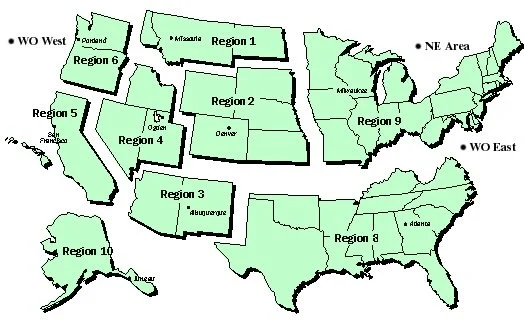
Figure 2. The nine regions of the current Forest Service. The Trump administration is eliminating these regions to consolidate bureaucratic power in Washington DC. To my amusement, a White House position paper justifying the move cited a 2007 paper by me (“Eliminating Forest Service Regional Offices: Replacing Middle Management with More On-the-Ground Restoration”). Source: USDA Forest Service.
A Departmental Transfer Proposal
Senator Mike Lee (R-UT), chair of the Senate Committee on Energy and Natural Resources, is proposing that the Forest Service be transferred from the US Department of Agriculture to the US Department of the Interior. This is the same Senator Lee who recently proposed selling off public lands.
See Public Lands Blog post: “While It Has Never Been Worse . . .”
While Senator Lee has no redeeming social value and his intent is as nefarious as it is disingenuous, the public lands conservation community should not reject a departmental transfer proposal out of hand just because it comes from someone with unclean hands.
Gifford Pinchot was the first chief of the Forest Service, the nation’s first trained forester, a socialist, and a friend of President Theodore Roosevelt. At the agency’s founding in 1905, the Agriculture Department was friendlier to Pinchot than the Interior Department, which was notoriously corrupt (for example, see Looters of the Public Domain; Embracing a Complete Exposure of the Fraudulent Systems of Acquiring Titles to the Public Lands of the United States [1908]). The result is that for more than a century, the National Forest System has been overseen by an agency that is at best a side hustle for the Department of Agriculture.
Agriculture secretaries are chosen because of their interest in soybeans and livestock, not spruces and larches. The Forest Service traditionally had great independence from the departmental mothership. Until relatively recently, the outgoing chief and the associate chief and deputy chiefs chose the new chief among themselves. All that was missing was white smoke rising from the chimney of the Agriculture Building on the National Mall. Now, the position of chief is fully politicized (as that person serves at the will of the president).
A politicized Forest Service can be better for public lands conservation than a supposedly independent bureaucracy, as that independence leans toward making stumps. The challenge to the public lands conservation community is electing presidents who will impose the enviros’ conservation will on the bureaucracy.
Breaking Up the Forest Service for Parts
The Forest Service currently has three official branches:
• the National Forest System
• state and private forestry
• research
The National Forest System branch of the Forest Service should be transferred from the US Department of Agriculture to the US Department of the Interior and placed under the administration of a new National Lands Conservation Service, which would also absorb the Bureau of Land Management and its landholdings. I recommend that the National Forest System be complemented with a National Desert and Grassland System.
The state and private forestry branch of the Forest Service should be transferred to the USDA Natural Resources Conservation Service, as NRCS already interacts with state and private entities.
The research branch of the Forest Service should be transferred to the USDI Geological Survey, which describes itself as “the science arm of the Department of the Interior.” The resulting agency could be renamed the National Natural Sciences Service. (It’s worth noting that from 1993 to 1996, during Clinton 1.0, there was a National Biological Service within the USDI.)
The de facto fourth branch of the Forest Service is its fire-industrial complex, which dwarfs the official three. These functions should be transferred to a new National Fire Service, housed in the Department of Homeland Security. Ideally, it would spend most of its resources making existing human infrastructure resistant to the inevitable fires and not waste resources ineffectively trying to extinguish wildfires.
A Closing Word: About Those Good Forest Service Employees
Yes, there are some—although more think they are doing good than are actually doing good. For example, even those biologists who are advocating for wildlife simply end up providing paperwork justification for timber sales. A few remaining good apples doesn’t mean that the barrel is not rotten.
Bottom Line: The Forest Service should be scrapped for parts, with its various functions transferred to existing or new federal agencies.