Governor Kotek’s “Ten Percent in Ten Years”
Top Line: Following an executive order from Governor Kotek, Oregon may significantly elevate the conservation status of 10 percent of the land and water in the state in the next decade—or it may not.

Figure 1. Oregon governor Tina Kotek (in office 2023–20??). Source: State of Oregon.
Last October, Oregon governor Tina Kotek (D) issued an executive order titled “Directing State Agencies to Take Urgent Action to Promote the Resilience of Our Communities and Natural and Working Lands and Waters.” Of most particular interest to public lands and waters aficionados is this item in the list of actions agencies are directed to take:
3. Conserve Natural Lands and Waters to Act as Resilience Anchors in the Face of Climate Change Impacts.
a. Ten Percent in Ten Years. Agencies are directed to protect, conserve, connect or restore ten percent of lands and waters in Oregon within ten years as compared to baseline conditions established for 2025. [emphasis added]
Don’t get too excited. “Ten Percent in Ten Years” (Ten in Ten) doesn’t mean full protection from any exploitation but merely moving the needle toward a little more protection, conservation, connection, or restoration than existed in 2025. Furthermore, whether this executive order results in the elevation of the conservation status of lands throughout the state or turns out to be a dud will depend upon its implementation.
Defining Those Words
Since the EO doesn’t define protect, conserve, connect, or restore, permit me to suggest what they should mean.
· Conserve should be defined as in the federal Endangered Species Act but applied more broadly: “to use . . . all methods and procedures which are necessary to bring any endangered species or threatened species to the point at which the measures provided pursuant to this chapter are no longer necessary” (US Congress 1973).
· Protect should mean “[to take] administrative, legal, economic, scientific and technological measures to rationally utilize resources, prevent environmental pollution, maintain ecological balance and ensure the healthy development of human society” (Lin et al. 2024).
· Connect should mean “[to ensure] animals can move across the landscape within their natural habitats, helping not only the many species that call [Oregon] home, but also aiding other natural processes such as nutrient cycling and seed dispersal” (Washington Department of Fish and Wildlife 2025).
· Restore should mean “[to assist] the recovery of an ecosystem that has been degraded, damaged, or destroyed” (Society of Ecological Restoration 2004).
Finding That Ten Percent
Oregon has 95,988 square miles of land and 2,391 square miles of water (inland and coastal), for a total of 98,379 square miles or ~62.9 million acres. (This calculation treats all square miles as statutory, with each square mile = 640 acres, even though the water area is officially measured in nautical square miles, with each square mile = 847.5 acres.) Ten percent of this total is ~6.3 million acres. To help you visualize how large an area this is: Crater Lake National Park has a total area of 183,224 acres, so it would take nearly thirty-five Crater Lake National Parks put together to equal 10 percent of Oregon’s acreage.
The State of Oregon owns just ~4.3 million acres of land and water, so even if the governor gets agencies to take action that protects, conserves, connects, or restores every acre of state-owned land and water, another ~2 million acres must somehow be brought into play.
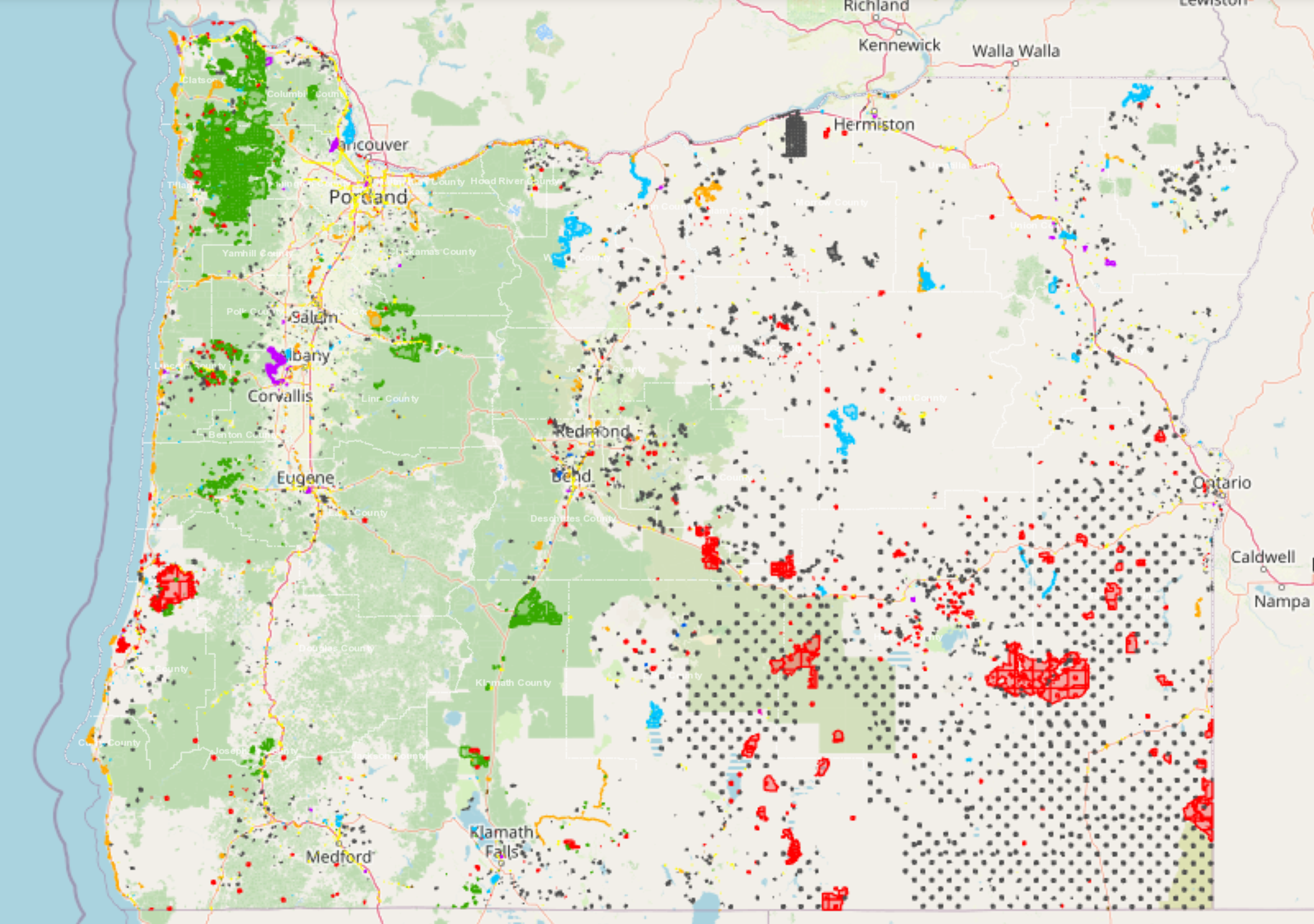
Figure 2. Shown in dark colors: State of Oregon lands (surface and/or subsurface ownership) of various kinds, totaling ~4.3 million acres. (Ignore the lighter green that is nothing but noise on the base layer of this online map.) The Oregon Territorial Sea is depicted as well. Source: Oregon Department of State Lands.
The State of Oregon does have general jurisdiction over private lands and some specific jurisdiction over certain resources on federal public lands. In the case of private lands, the State of Oregon has jurisdiction over fish, wildlife, and water on all lands in the state, regardless of ownership. The state issues water rights and permits to take fish and wildlife and can and does regulate all three. The state also has jurisdiction over noise pollution on all lands.
Determining What Should Count
The level of conservation on particular Oregon lands today ranges from 0 to 100. It is not that difficult to measure. At first glance, any elevation of conservation on Oregon lands should count toward the ~6.3 million acres. However, not quite so fast.
Various state agencies have ongoing programs that will result in elevated conservation as those actions are implemented over time. If counted, merely continuing those programs will result in significant movement toward Ten in Ten. For example, the Oregon Department of Fish and Wildlife and the Oregon Watershed Enhancement Board spend millions of dollars annually to improve fish passage by removing dams, replacing culverts and tide gates, and the like. While the funding is periodically renewed, these actions can fairly be described as “business as usual.” Only if Oregon accelerates the pace and scale (by spending more money than it has been) should the additional increment count toward Ten in Ten.
Another example is compliance with state or federal laws that must be done in any case. Protecting or restoring habitat for imperiled species or taking steps to restore degraded streams is required by law and must be done irrespective of Ten in Ten. Only if Oregon does more than is required by law should it count toward Ten in Ten. Consider the greater sage-grouse, which can be found on hundreds of thousands of acres of state-owned rangelands in the Oregon portion of the Sagebrush Sea. The law requires that the species not go extinct. Restoring grouse numbers (by protecting or restoring its habitat) to prevent extinction is already required by law and therefore is business as usual. Only conserving and restoring enough habitat for there again to be a healthy and sustainable huntable surplus should count toward Ten in Ten.
I’m sure Governor Kotek intends her executive order to mean more than business as usual and that the State of Oregon should do more than it is doing now, as the executive order speaks of Oregon being at
an inflection point as changing climate and ocean conditions are impacting Oregon’s landscapes, waters, communities, and local economies with increased temperatures, warming surface waters, changing precipitation patterns, reduced snowpack, hotter and drier summers, sea-level rise, diminishing water supplies, habitat constraints to iconic species, and more frequent and damaging wildfires and extreme weather events.
It may be that more than one individual act of protection, conservation, connection, or restoration may occur on the same acre. While highly desirable, such should not result in double counting of those acres toward Ten in Ten.
The state’s Ten in Ten effort should be biased toward multifactor, rather than single-factor, protection, conservation, connectivity, or restoration. In other words, protecting entire areas rather than just addressing one ecological irritant will result in more enduring conservation for this and future generations of Oregonians.
Some Suggestions
Although far from a comprehensive list, following are ten suggestions that could significantly contribute to Ten in Ten by moving the needle in terms of biodiversity conservation, watershed restoration, and/or climate mitigation and adaptation.
1. End livestock grazing in Oregon wildlife areas. The Oregon Department of Fish and Wildlife often allows livestock grazing to continue after it acquires a property for wildlife conservation. The agency may pretend it is using livestock to manage wildlife habitat, but it’s really about keeping local livestock interests off the agency’s bureaucratic back. This practice should end. Any forage that goes through one 1,000-pound domestic cow could have been consumed by one bison, 7.8 mule deer, 2.1 elk, 10.8 pronghorn, 6.9 bighorn sheep, or 1.2 moose (Rintamaki 1988). Not to mention that not having domestic livestock wallowing in and next to streams would improve water quantity and quality, and as a result improve native fish numbers.
2. End commercial and recreational trapping of beaver on all public lands in Oregon, with an exception to take problematic beavers harming critical infrastructure or agricultural crops. Current law prohibits the commercial or recreational taking of beaver within 200 feet of the ordinary high water mark of any stream in Oregon that flows through, adjoins, or is on public land and does not meet water quality standards according to the US Environmental Protection Agency (ORS 498.066, 2a and b). According to this law, if the stream is no longer impaired because the beavers have returned and fixed the problem, trapping can resume (thereby reversing the protecting, conserving, connecting, and restoring trends). The law should be amended to acknowledge that even stream segments that don’t violate water quality standards could benefit from more beavers, resulting in even better water quality and quantity, and that there are lots of wetlands or former wetlands more than 200 feet from a stream course on public lands where beavers should not be trapped.
3. Expand the area of marine reserves in Oregon’s Territorial Sea. Currently, there are five marine reserves (MRs) offshore Oregon, totaling 40 square miles, where no extraction, including fishing, is allowed. There are another nine adjacent marine protected areas (MPAs), totaling another 77 square miles, where the extraction of fish is allowed (Hayden-Lesmeister 2019). That works out to be 2.8 percent and 5.4 percent, respectively, of the 1,435 square miles in the Oregon Territorial Sea. The MPAs should be elevated to MRs and more MRs established. In addition, MPAs should be everywhere in the Oregon Territorial Sea save for a few areas reserved for tidal energy development (but not offshore wind towers) and submerged communications cables.
4. Protect the quiet in natural landscapes for people and wildlife. In 1972, the Oregon Environmental Quality Commission promulgated Oregon Administrative Rule 340-13-0005 to “maintain the environment of wilderness areas essentially in a pristine state and as free from air, water, and noise pollution as is practically possible and to permit its alteration only in a manner compatible with recreational use and the enjoyment of the scenic beauty and splendor of these lands by the citizens of Oregon and of the United States.” This rule targeted the proposed mining of Rock Mesa in the Three Sisters Wilderness for pumice to be used as grill scrapers and bird beak sharpeners. Essentially, the rule told the US Pumice Company that it could mine the area but only with a broken pick and a three-legged burro. Rock Mesa remains undefiled to this day. The noise rule should be extended to, but not limited to, (1) Forest Service wilderness study areas, roadless areas, special interest areas, and research natural areas; (2) Bureau of Land Management wilderness study areas, areas of critical environmental concern, research natural areas, and lands with wilderness characteristics; (3) National Wildlife Refuge System units; (4) National Park System units; (5) Oregon Scenic Waterways; and (6) Oregon wildlife areas.
5. Protect the remaining unprotected older forest stands on state forestlands. There are three kinds of state forestlands:
(1) state forests administered by the Oregon Board of Forestry (Tillamook, Clatsop, Santiam, Gilchrist, Sun Pass, and other miscellaneous lands);
(2) forestlands administered by the Oregon Department of State Lands; and
(3) the Elliott State Research Forest (ESRF), also managed by the Oregon Department of State Lands.
The first two kinds are mostly administered under a new forest management plan / habitat conservation plan that dedicates most—but not all—of any remaining natural older forest to conservation reserves. A few thousand acres of older forest on the ESRF are still available for logging. If logging is tried, it will be extremely controversial. The social license to log older forests on public lands in Oregon has expired, and this should be acknowledged in policy.
6. Prohibit salvage logging in critical state forests. Often, even in areas dedicated to conservation and recreation, if a stand-replacing event such as high wind or wildfire occurs, the managing agency immediately seeks to log in the name of salvaging the trees (now seen only as standing or fallen logs). The biological diversity of an intensely burned or blown-down forest can exceed that of an old-growth forest it may have replaced. Left to nature, the old-growth forest will eventually return. Not logging a disturbed forest stand also prevents the emission of huge amounts of carbon into the atmosphere. Salvage logging of stands sixty-five years old and older should be prohibited in Oregon state forests, Oregon state parks, Oregon wildlife areas, and the Elliott State Research Forest and other forestlands administered by the Oregon Department of State Lands.
7. Conserve ecosystem carbon in state-owned forestlands, grasslands, deserts, and wetlands (salt and fresh). It turns out that the same management actions that conserve biodiversity and protect or restore watersheds also result in more carbon being stored in vegetation and less carbon being transferred from ecosystems (where it is a good) to the atmosphere (where it is a is bad). It also turns out that in exchange for a landowner committing to take actions to conserve carbon, the landowner can be paid money.
8. Acquire more water rights for public values. Oregon has in the past acquired water rights from private parties and rededicated them to in-stream uses for fish, wildlife, recreation, scenery, etc. It could do more of this.
9. Regulate the use of motorized transportation and drones on Oregon-owned waterways. The state owns hundreds of thousands of acres of “navigable waters” and could regulate uses (through bans, speed limits, and such) to reduce conflicts with fish and wildlife. These uses could include but not be limited to recreational drone use and motorized transportation.
10. Acquire more lands for conservation as state parks, wildlife areas, and forests. The State of Oregon could create more state parks (focusing on natural values, not disc golf courses), state forests, and state wildlife areas.
One more thing: Stop granting new water rights in fully appropriated watersheds. Under Oregon water law, anyone can apply for a water right on streams where all water has already been appropriated. New water rights granted just become junior water rights that get cut off in favor of senior water rights in times of drought. This arrangement creates constituents for new dams, among other things. While it would help conservation if Oregon stopped granting new water rights in fully appropriated watersheds, such would not actually protect, conserve, connect, or restore, but would simply not make matters worse, so I don’t think such should count toward Ten in Ten even though I think it should be done.
The Kotek Conservation Legacy
The conservation legacy of Governor Tina Kotek is currently a very mixed one. Even assuming Oregonians re-elect her for a second term, Governor Kotek will leave office in early 2031. Therefore, it would be prudent for the governor to truncate her Ten in Ten to Ten in Five. (And it would be very okay for the governor to do more than 10 percent!)
Oregon government has a slew of boards and commissions that oversee state agencies. The members are nominated by the governor and often confirmed by the Oregon State Senate. In any case, these members ultimately serve at the pleasure of the governor. Many board members or commissioners (like some members of the Board of Forestry) have conflicts of interest that might make them unwilling or unable to help the governor attain her Ten in Ten goal. It may be that to achieve Ten in Ten, the governor will have to prevail upon some reluctant board members or commissioners—including expressing her displeasure by replacing them.
Bottom Line: A vigorous implementation of Governor Kotek’s “Ten Percent in Ten Years” could burnish her environmental record to a shine—and leave a better Oregon for this and future generations.
References
Hayden-Lesmeister, Anne. 2019. “A Brief History of Oregon’s Marine Reserves.” Oregon State University, Sea Grant Scholars blog.
Kotek, Tina. October 2025. “Directing State Agencies to Take Urgent Action to Promote the Resilience of Our Communities and Natural and Working Lands and Waters.” Oregon Governor Executive Order 25-26 (pdf).
Lin, Li-Wei, Jao-Hong Cheng, and Kuo -Liang Lu. 2024. “The Impact of Environmental Protection, Economic Development, Social Responsibility and Governance on the Sustainable Development of Enterprises.” Discover Sustainability 5(1).
Rintamaki, Richard C. 1988. “Forage Utilization by Game Species.” US Department of Agriculture, Wyoming, Soil Conservation Service, Biology No. 37 technical note (pdf).
Society for Ecological Restoration International Science and Policy Working Group. 2004. The SER International Primer on Ecological Restoration (pdf).
US Congress. 1973. Endangered Species Act. 16 USC 1532(3).
Washington Department of Fish and Wildlife. 2025. Habitat Connectivity (web page).